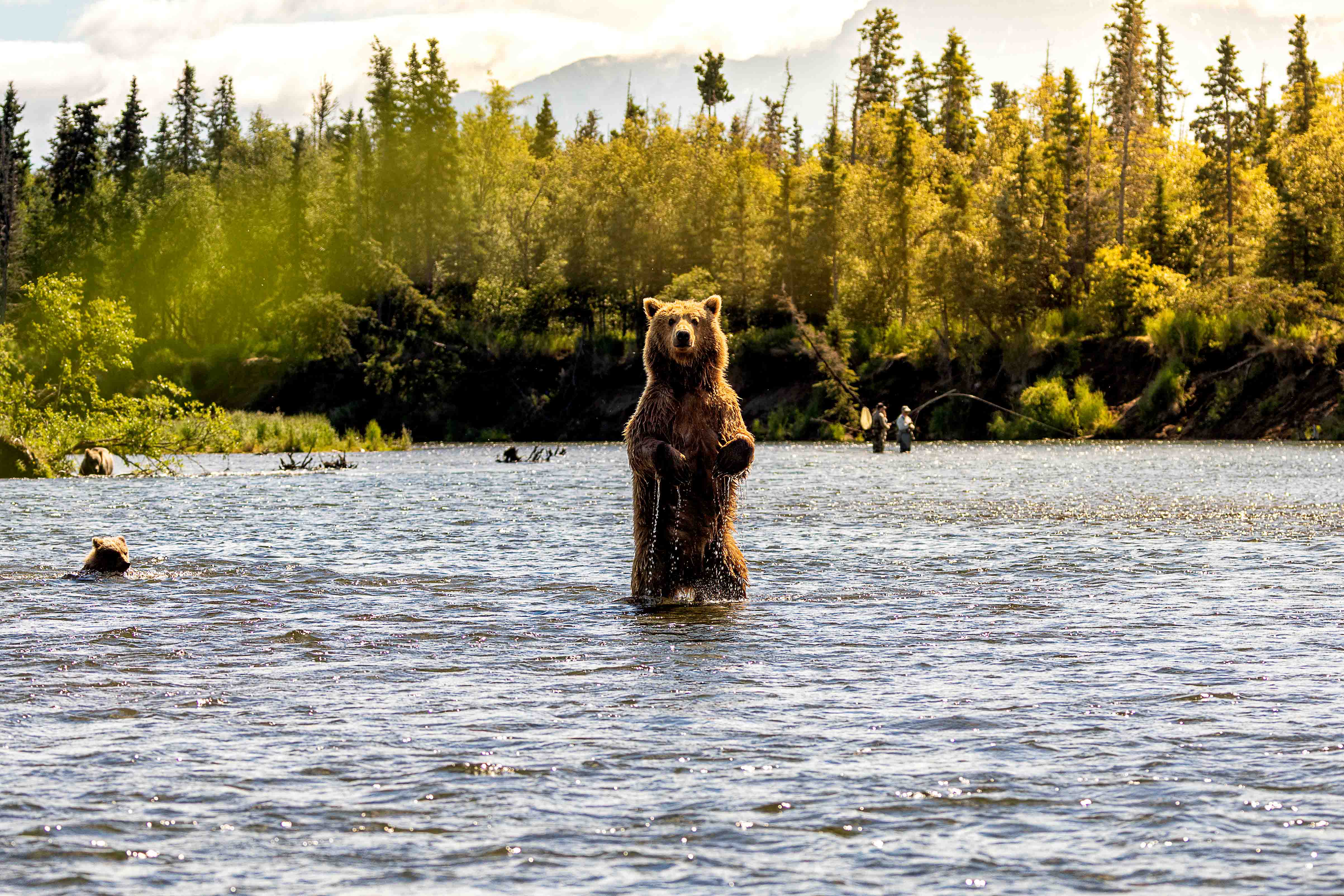
Grizzly Photograph from Katmai National Park: These Photographs Almost Cost Me Everything…
The roar came first.
Not loud.
Deep.
The kind of sound you don’t just hear…
You feel.
It rolled through the forest like distant thunder before exploding somewhere only yards away.
Every bird in the brush fell silent.
Then I saw him.
A young brown bear burst through the thick green brush, flattening waist-high vegetation with every stride as he angled toward the trail where I stood.
Twenty feet.
Maybe less.
The damp earth shifted beneath my boots as I instinctively stepped backward, desperately trying to keep the trunk of a spruce tree between us.
My camera was already packed away.
There wasn’t another photograph to take.
Only decisions.
Every instinct inside me screamed the same thing.
Run…
For one suspended moment, everything else disappeared.
The river.
The mountains.
The birds.
Even time itself seemed to stop.
As I stood there staring into the eyes of a wild grizzly, three months of my life rushed through my mind.
Leaving behind the security of a six-figure career.
Hooking a camper to my truck.
Thousands of miles of highway.
Broken fishing rods.
Two weeks of relentless rain.
A trailer slowly tearing itself apart.
Everything I’d risked…
Everything I’d sacrificed…
Had somehow led to this single moment…
These Photographs Almost Cost Me Everything…
At first, I thought this story was about the bear that charged me.
Looking back…
I don’t think it ever was.
This is a story about a mother.
A tiny spring cub.
A young bear still trying to figure out where he belonged.
A photographer chasing the wrong photograph.
And one quiet lesson hidden in the Alaskan wilderness that would forever change the way I look at this image.
It’s the story behind a photograph that almost never happened.
And the lesson I’ll carry with me long after the ink on this print has faded.
The Dream Worth Chasing
When people stand in front of one of my photographs, they usually see the ending.
A grizzly frozen in time.
A mountain glowing beneath the first light of sunrise.
A moment that feels almost impossible.
What they never see…
Is everything that had to happen before the shutter ever clicked.
The miles.
The uncertainty.
The sacrifices.
The quiet doubts that kept asking whether I was making the biggest mistake of my life.
Photography has never been just a hobby.
Long before it became my business, it became the way I experienced the world.
While most vacations were built around sleeping in and relaxing…
Mine revolved around 3:00 a.m. alarms.
Headlamps cutting through dark forests.
Checking weather forecasts one last time before crawling into a sleeping bag.
Standing in freezing rivers before sunrise because the light might only last five minutes.
Every photograph became an excuse to explore somewhere I’d never been.
Every trip reminded me how much of the world I still hadn’t seen.
Like most people, though…
Adventure had to compete with responsibility.
A career.
Bills.
Comfort.
The kind of life that makes perfect sense on paper.
Then life changed.
And somewhere in the middle of that change, one question quietly replaced another.
Instead of asking…
“What if this doesn’t work?”
I found myself asking something far more uncomfortable.
“What if I never try?”
That question followed me everywhere.
It rode beside me on my commute.
It waited while I edited photographs late into the night.
It whispered every time I looked at another photographer’s image from a place I’d only dreamed about visiting.
Eventually, I realized something.
The greatest risk wasn’t driving thousands of miles to Alaska.
It wasn’t spending money I couldn’t guarantee I’d ever earn back.
It wasn’t living out of a camper for months.
The greatest risk…
Was reaching the end of my life wondering what might have happened if I’d never gone.
So one morning, I stopped wondering.
I loaded my camera gear into the truck.
Hooked up the camper.
Packed everything I thought I’d need for the long road north.
My two German Shorthaired Pointers, Jäger and Moose, jumped into the truck with the same excitement they showed before every adventure, completely unaware that this journey would be unlike anything we’d ever experienced.


I closed the tailgate.
Took one last look behind me.
Then pointed the truck toward Alaska.
I thought I was chasing one extraordinary photograph.
I had no idea I was really driving toward a lesson that would change the way I looked at every photograph I’d make after it.
Why Alaska?
People often ask photographers why we travel so far for a single photograph.
The easy answer is…
Beautiful places.
Snow-covered mountains.
Wild rivers.
Golden light.
Those things certainly matter.
But they aren’t the real reason.
The truth is…
We’re chasing a feeling.
The feeling that somewhere in the world, life is unfolding exactly as it has for thousands of years…
Whether we’re there to witness it or not.
We’re chasing those impossibly rare moments that exist for only a heartbeat before disappearing forever.
Moments no one can recreate.
Moments no amount of planning can guarantee.
I’ve been chasing those moments for as long as I can remember.
Long before I owned a professional camera.
Long before I knew what aperture or shutter speed meant.
As a kid, I was fascinated by wildlife.
Not the animals pacing behind glass at a zoo.
The wild ones.
The ones that answered to no one.
The ones that reminded you the world didn’t belong to us.
I remember sitting in front of the television completely captivated by nature documentaries.
Every time Alaska appeared on the screen, everything else disappeared.
Towering mountains.
Endless rivers.
Bald eagles drifting through impossibly large skies.
And then…
The bears.
Massive.
Intelligent.
Powerful.
Completely untamed.
There was something about them that demanded respect.
They weren’t performing for cameras.
They weren’t trying to impress anyone.
They were simply surviving in a place where nature still made the rules.
Even then, I remember wondering what it would feel like to stand far enough away to witness that world with my own eyes.
Not through a television.
Not through someone else’s photograph.
For years, that dream quietly stayed in the back of my mind.
As I grew older and photography became more than a hobby, I found myself returning to the same place over and over again.
Katmai National Park.
More specifically…
Brooks Falls.
Among wildlife photographers, the name carries a certain weight.
People don’t just visit Brooks Falls.
They talk about it.
Study it.
Dream about it.
It’s one of those places that lives in your imagination long before you ever arrive.
Every summer, millions of salmon fight their way upstream.
The largest brown bears on Earth gather to meet them.
For a few short weeks, one of the greatest wildlife spectacles on the planet unfolds exactly as it always has.
No audience required.
If Yellowstone is where many wildlife photographers first fall in love with bears…
Brooks Falls is where they hope to create the photograph they’ll remember for the rest of their lives.
I wasn’t chasing someone else’s image.
I wasn’t trying to recreate the famous photographs I’d admired for years.
I wanted something far more difficult.
I wanted my own story.
I imagined cold mornings wrapped in golden light.
Powerful bears standing in rushing water.
The sound of salmon splashing beneath the falls.
I imagined finally standing in the place I’d dreamed about since I was a kid and coming home with a photograph worthy of that dream.
What I didn’t know…
Was that Alaska had no interest in following my plans.
And the photograph I’d treasure most…
Wouldn’t be the one I’d spent years imagining.
The Long Road North
The decision itself only took a few minutes.
Living with it would take thousands of miles.
A few days after committing to the trip, my driveway looked like controlled chaos. Camera bodies. Lenses. Tripods. Fly rods. Camping gear. Food bins. Dog beds. Every square inch of my truck and camper had to serve a purpose because, for the next several months, they wouldn’t just be transportation.

They would be home.
Jäger and Moose watched with the excitement only dogs can have. They had no idea we were about to leave everything familiar behind. To them, it was just another ride in the truck. To me, it felt like I was crossing an invisible line.
There was no turning back.
As Utah disappeared in my rearview mirror, so did the routine I’d spent years building.
The alarm clock.
The meetings.
The predictable schedule.
For the first time in a long time, I had no idea what the next few months would look like.
That uncertainty was equal parts terrifying and exhilarating.
Every day on the road developed its own rhythm. Wake up. Make coffee. Walk the dogs. Check the weather. Study maps. Chase good light. Drive until I found the next place that made me pull over. Sometimes I’d spend hours waiting for a landscape to come alive. Other days I’d drive hundreds of miles without taking a single photograph worth keeping.
Nature doesn’t care how far you’ve traveled.
It doesn’t know how much money you’ve spent.
It doesn’t reward effort simply because you showed up.
It gives you the moment—or it doesn’t.
Some evenings I fell asleep exhausted, convinced I’d captured something special.
Other nights I climbed into bed wondering if I was making the biggest mistake of my life.
Every gallon of diesel.
Every campground.
Every meal.
Every unexpected expense.
It all added up, and none of it came with a guarantee that I’d return with a single photograph anyone would ever want to hang on their wall.
But somewhere between the endless highways, mountain passes, and quiet mornings with two dogs who were blissfully unaware of my worries, something began to change.
The farther north I drove, the less this trip became about escaping the life I’d left behind.
It became about discovering the life I wanted to build.
Looking back now, I realize that Alaska was already teaching me its first lesson.
You can’t rush something worth experiencing.
The mountains reveal themselves when the clouds decide to move.
Wildlife appears when it’s ready—not when your schedule says it should.
The best photographs don’t happen because you force them.
They happen because you stay long enough to receive them.
I didn’t know it then, but that lesson would be tested over and over again before I ever reached Katmai National Park.
And when I finally did…
Alaska had one more surprise waiting for me.
Alaska Fights Back
It’s easy to fall in love with Alaska on Instagram.
Snow-covered peaks glowing in perfect light.
Crystal-clear rivers winding through untouched valleys.

Brown bears catching salmon beneath golden sunsets.
Those moments exist.
But they’re only a fraction of the story.
What photographs rarely show are the days in between.
The days when nothing goes according to plan.
The farther north I drove, the more I realized something.
Alaska doesn’t reward ambition.
It rewards patience.
Morning after morning, I’d wake before sunrise convinced that today would be the day.
I’d unzip the camper door…
…and hear it.
Rain.
Again.
The steady rhythm of raindrops drumming against the aluminum roof had become the soundtrack of the trip.
My rain jacket never seemed completely dry.
Neither did my boots.
Every morning they carried the same damp chill from the day before.
Coffee helped.
Hope helped too.
But some mornings, neither lasted very long.
I’d climb behind the wheel and spend hours staring through windshield wipers working overtime, watching walls of gray swallow mountains I’d only catch glimpses of for a few seconds before they disappeared again.
Some days I hiked for miles with a camera on my back.
I’d return exhausted.
Cold.
Wet.
The memory cards inside my camera looked exactly the same as when I’d left camp.
Empty.
Wildlife doesn’t appear because you’ve traveled thousands of miles to find it.
It appears because it wants to.
And sometimes…
It simply doesn’t.
Then Canada decided to test me in a different way.
The farther north I drove, the rougher the roads became.
What looked smooth from a distance suddenly turned into towering frost heaves that launched the truck and trailer into the air before slamming them back onto the pavement.
Potholes appeared with almost no warning.
Every impact echoed through the cab with a heavy thud, followed by another groan from the camper behind me.
Then…
BANG.
The truck lurched.
I eased onto the shoulder.
One of the trailer tires had exploded.
The smell of hot rubber filled the air as I climbed out.
Fortunately, I had a spare.
I wrestled it into place beside the highway, wiped the grease from my hands onto my jeans, and climbed back into the truck.
“Well…” I laughed to myself.
“That could’ve been worse.”
Looking back…
I couldn’t have been more wrong.
What I didn’t know was that every frost heave…
Every pothole…
Every violent impact I’d shrugged off…
Was quietly damaging something I couldn’t see.
A problem that would wait patiently for weeks before introducing itself.
So I kept driving.
Fishing became its own lesson in humility.
I broke rods.
Lost fish.
Spent entire days standing waist-deep in glacial rivers so cold they numbed my legs until I could barely feel the rocks beneath my boots.

Some evenings I returned to camp so exhausted that dinner became whatever I could throw together with one burner and the little energy I had left.
Meanwhile…
The fuel gauge kept falling.
Campground fees kept adding up.
The Katmai flight wasn’t getting any cheaper.
Every extra day in Alaska meant another day of expenses.
Another day wondering if I’d drive all this way only to return home without a single photograph worthy of hanging on a wall.
Then came the rain.
Not an afternoon storm.
Not a rainy weekend.
Two weeks.
Nearly nonstop.
Clouds swallowed mountain ranges that locals insisted were spectacular.
Trails dissolved into mud.
Camera gear stayed wrapped in rain covers.
Even inside the camper, moisture found its way onto the windows each morning, turning the outside world into little more than gray silhouettes.
Eventually, the rain stopped feeling temporary.
It simply became life.
And somewhere in the middle of those endless gray days, another doubt crept in.
What if I’d come all this way…
…and still wasn’t prepared?
It wasn’t my camera I questioned.
It was the lens attached to it.
For Katmai, I’d packed Canon’s RF 100-500mm.
I love that lens.
It’s incredibly sharp.
Reliable.
Versatile.
But there’s one thing it isn’t.
Fast.
Everywhere I looked, other wildlife photographers carried giant prime lenses.
400mm f/2.8.
600mm f/4.
Massive pieces of glass capable of gathering twice as much light as mine.
The weather forecast only made those doubts louder.
Clouds.
Rain.
Overcast skies.
Exactly the conditions where every stop of light matters.
I started wondering if I’d made a mistake.
Would I spend thousands of dollars getting to Katmai…
Only to discover my lens wasn’t enough?
Would I have to push my ISO so high that every image fell apart before I ever printed it?
Would all this sacrifice…
All these miles…
All these setbacks…
Lead to photographs that never matched the vision I’d carried for years?
Then, one quiet afternoon, I caught something in my rearview mirror.
The trailer looked…
Different.
The tongue seemed lower than I remembered.
At first, I dismissed it.
Maybe it had always looked like that.
Maybe the extra weight had settled things a little.
I stopped anyway.
Adjusted the hitch.
Stepped back.
Something still wasn’t right.
I walked closer.
Knelt in the gravel.
Ran my hand along the steel.
That’s when I saw it.
The tongue wasn’t low.
It was bent.
I crouched lower.
Dirt had collected inside what looked like a scratch.
I brushed it away with my thumb.
It wasn’t a scratch.
It was a crack.
Then I found another.
And another.
The welds holding the tongue to the trailer frame had begun tearing apart.
Not chipped.
Not scratched.
Cracked.
My stomach sank.
The roads through Canada hadn’t simply blown a tire.
They’d been slowly ripping my home apart for weeks.
And I’d never noticed.
For the first time since leaving Utah…
I wasn’t thinking about bears.
I wasn’t thinking about photographs.
I wasn’t thinking about fishing.
I was wondering whether the little camper I’d been living in for weeks was even safe to tow another mile.
Then my phone rang.
Katmai.
Weather permitting.
Just like that…
Every problem I’d been carrying suddenly took a step backward.
The dream I’d driven thousands of miles to chase was finally within reach.
The Call I’d Been Waiting For
By the time I reached Canada, one thing had become painfully obvious.
Alaska wasn’t following my schedule.
I had originally planned my trip around the salmon run, but after talking with local fishermen and keeping a close eye on the fish counts, I realized the run was behind.
There were simply fewer fish than expected.
At first, I was disappointed.
Then I realized something unexpected.
The delay had given me something I hadn’t planned for.
Time.
If I couldn’t photograph bears yet, maybe this was my opportunity to finally make it happen.
So every evening, after walking the dogs and making dinner in the camper, I started researching.
I wasn’t looking for the cheapest tour.
I wasn’t looking for the biggest company.
I was looking for someone I could trust.
The more I searched, the more one name kept coming up.
Alaska Bear Adventures.
Photographers spoke highly of them.
Travelers trusted them.

Most importantly, everything I read suggested they respected the bears as much as they respected the people coming to see them.
That mattered to me.
I didn’t want to photograph wildlife from a place that treated animals like an attraction.
I wanted to experience Katmai the right way.
So I booked my flight.
For the first time since leaving Utah, the dream suddenly had a date attached to it.
It was happening.
Or at least…
I hoped it was.
As I started reading through the pre-trip information, one detail caught my attention.
No bear spray or weapons of any kind
Because we’d be flying in a small bush plane, it wasn’t allowed on board.
The canisters are pressurized, making them unsafe to fly with.
I understood the reason.
It still made me pause.
I’d spent weeks in Alaska carrying bear spray almost everywhere I went.
I always have my lever action 45-70 in case Jager or Moose stir up wildlife.
Now I was about to walk into one of the highest concentrations of brown bears on Earth…
Without it.
The rangers and guides would be carrying protection.
They did this every day.
They knew these bears.
I trusted them.
Still…
There’s something unsettling about realizing you’re about to step into a world where the biggest predator isn’t the one adapting to you.
You’re adapting to it.
That night, I laid out my camera gear one last time.
Charged batteries.
Formatted memory cards.
Checked my lenses.
The weather forecast hadn’t improved.
Clouds.
Rain.
Low light.
Exactly the conditions I’d been dreading with my 100-500mm lens.
I climbed into bed wondering which would be the bigger obstacle.
The weather.
Or the bears.
The next morning, I would discover the answer wasn’t either of those.
Into the Bears’ World
At exactly 3:00 that morning, my eyes opened before the alarm ever had a chance.
For a moment, I didn’t move.
I just listened.
Silence.
After nearly two weeks of rain drumming against the roof of my camper, the silence almost sounded unfamiliar.
No steady tapping on aluminum.
No wind rocking the trailer.
Just stillness.
I opened the door and stepped outside.
The cold air immediately filled my lungs, crisp enough to make me pull my jacket tighter around my neck. Somewhere across the bay I could smell the faint mix of saltwater and wet earth, the kind of smell that only exists in places where the wilderness still owns the landscape.
I wrapped both hands around a mug of coffee and looked up.
For the first time in what felt like forever…
The sky was clear.
Across the bay, the volcanoes were beginning to catch the first light of morning.

The peaks glowed with deep shades of gold and orange while everything below remained wrapped in cool blue shadows. It almost looked as if the mountains were creating their own light.
Steam drifted from my coffee into the cold morning air.
I don’t remember taking a single sip.
I just stood there.
For weeks, Alaska had tested every ounce of patience I had.
The rain.
The broken trailer.
The endless uncertainty.
That morning…
It felt like Alaska was finally smiling back.
“Maybe…”
“Just maybe…”
“Today’s the day.”
For the first time in weeks, the doubts became quieter.
Maybe the weather would cooperate.
Maybe my 100-500mm lens would be enough.
Maybe everything I’d sacrificed to get here would finally be worth it.
Coffee had never tasted so good.
Neither had hope.
I don’t remember much about climbing into the bush plane.
I remember how it felt.
The excitement that had been building for thousands of miles suddenly became real.
This wasn’t another campground.
This wasn’t another scenic overlook.
Everything I’d dreamed about since I was a kid was now less than an hour away.889
The plane was smaller than I expected.
Every backpack.
Every camera.
Every pound was weighed before being loaded aboard.
Once everyone squeezed into their seats, there wasn’t much room left.
The pilot closed the door.
The engine fired to life.
Within seconds the quiet morning was replaced by the steady roar of the propeller. The entire airplane vibrated beneath my boots.
Conversation became impossible.
So I looked out the window.

And thought...
I thought about the cracked trailer.
The weeks of rain.
The blown tire.
The broken fishing rods.
The empty memory cards.
The doubts that had followed me all across Alaska.
Then I realized something.
None of it mattered anymore.
If this flight made it through the weather…

I was finally going to stand in Katmai National Park.
The plane lifted from the water.
Almost immediately, civilization disappeared behind us.
Roads became rivers.
Rivers became mountains.
The farther we flew, the smaller people seemed.
No highways.
No powerlines.
No buildings.
Just endless wilderness stretching farther than I could comprehend.
The morning sunlight spilled across glaciers, braided rivers, and valleys untouched by roads.
For miles…
There wasn’t a single sign that another human being had ever existed.
It was breathtaking.
It was humbling.
And if I’m honest…
It was intimidating.
Somewhere below us lived thousands of brown bears.
Not in fenced enclosures.
Not waiting for tourists.
Living exactly as they had for thousands of years.
For the first time during my entire trip…
I wasn’t wondering whether I’d get the photograph.
I was wondering whether I was ready to enter their world.
One sentence from the guides kept replaying in my mind.
“Remember…”
“You’re entering their world.”
Not ours.
Theirs.
As the plane began descending, I pressed my forehead against the cool window.
The coastline slowly sharpened into focus.
Braided rivers.
Dark spruce forests.
Wide beaches.
Then…
The floats kissed the water.
A gentle spray arced away from both sides of the plane as we skimmed across the bay before slowly gliding onto the beach.
The engine wound down.
The propeller slowed.
Then…
Silence.
No more engine.
No more vibration.
Just waves softly rolling against the floats and gulls calling somewhere overhead.
For the first time in weeks…
There was nowhere else to drive.
No more miles.
No more planning.
No more waiting.
I grabbed my camera bag and stepped onto the beach.
The sand was cool beneath my boots.
A salty breeze drifted in from the bay.
Behind me, the floats clicked and creaked as the plane settled against the gentle waves.
Everything felt…
Different.
Cleaner.
Wilder.
The short trail leading away from the beach looked almost ordinary.
Until I looked down.
There, pressed deep into the damp sand, was the largest paw print I’d ever seen.
I instinctively stepped beside it.
My boot looked ridiculously small.
The edges of the track were still crisp.
The sand hadn’t yet softened them.
A bear had stood exactly where I was standing.
Not sometime this week.
Not yesterday.
Recently.
Very recently.
A strange feeling settled into my stomach.
For the first time…
This wasn’t a dream anymore.
This wasn’t a wildlife documentary.
This wasn’t Yellowstone.
I wasn’t looking for bears anymore.
I was already standing where one had been.
The trail led us to what everyone casually called Bear School.

The name made a few people smile.
The lesson didn’t.
The ranger welcomed us, handed each of us a small pin, and explained how to safely exist around one of the world’s largest predators.
Most of it sounded simple.
Stay together.
Respect their space.
Pay attention.
Then came the sentence I’d replay in my head again only hours later.
“Whatever happens…”
”…don’t run.”
Simple words.
Easy to hear.
Much harder to imagine following.
As the orientation wrapped up, I clipped the pin onto my jacket and reached for the door.
Then the ranger calmly raised his hand.
“Everyone back inside.”
Conversation stopped.
Through the classroom window I saw why.
A sow.
Her spring cub.
They were walking quietly past the building, completely unconcerned by the people watching them through the glass.
The rangers temporarily closed the trail, patiently waiting for the bears to continue on.
I just laughed.
I’d traveled thousands of miles to photograph brown bears…
…and my camera was still buried inside my backpack.
“Seriously?”
“I already missed one.”
Or so I thought.
Once the trail reopened, I followed the boardwalk toward Brooks Falls.

The forest smelled of wet spruce and moss.
The river grew louder with every step.
Then the trees opened.
The sound hit me first.
Rushing water.
Splashing salmon.
Gulls screaming overhead.
The occasional crack of jaws meeting fish.
I looked down.
Bears.
Everywhere.

Some stood chest-deep in the current, waiting with incredible patience.
Others lunged at salmon exploding from the water.
Huge bears ignored one another as if sharing the same river had become routine.
Young cubs wrestled along the shoreline, completely unaware that they were living in one of the wildest places left on Earth.

No fences.
No barriers.
No handlers.
Just life.
Raw.
Ancient.
Unscripted.
And somewhere among all those bears…
Was one mother.
One young bear still trying to figure out where he belonged.
And a story that would change the way I looked at this photograph forever.

Brooks Falls
The Photograph Everyone Comes For
Long before I ever set foot in Katmai National Park, I already knew the photograph.
If you’ve ever searched for Brooks Falls, you’ve seen it too.
A massive brown bear suspended in midair.
A salmon frozen beneath it.
Water exploding in every direction.
Photographers simply call it…
The Leap.
It’s the image that inspires people from all over the world to travel thousands of miles to a place most will only visit once.
Of course…
I wasn’t the only one chasing it.
Access to the Brooks Falls viewing platform is tightly controlled. Only a limited number of people are allowed on the platform at one time, and everyone gets just thirty minutes before rotating out.
So I added my name to the waiting list.
Then I waited.
The roar of Brooks Falls never stopped.
Thousands of gallons of glacial water thundered over the edge every second, shaking the wooden platform beneath my boots. Conversation was almost impossible. People pointed more than they talked.
Gulls wheeled overhead, their sharp cries echoing through the canyon as they waited for bears to miss their catch.
Every few seconds a salmon launched itself from the whitewater, flashing silver in the morning sun before disappearing back into the foam.
Every jump made photographers instinctively lift their cameras.
Maybe…
This one.
Nearly an hour later, someone called my name.
This was it.
Thirty minutes.
That’s all the time I’d have at one of the most famous wildlife photography locations on Earth.
I stepped onto the platform and immediately felt the pressure.
Every photographer around me knew exactly why they were there.
No one was sightseeing.
Every lens was aimed at the falls.
Every finger rested lightly on a shutter button.
Waiting.
Hoping.
I found an opening along the railing and quickly unpacked my gear.
One piece of equipment immediately proved its worth.
Tripods aren’t allowed on the Brooks Falls platform. There simply isn’t enough room, and the last thing anyone wants is a maze of tripod legs blocking the narrow viewing deck.
Instead, I reached into my bag and pulled out my Really Right Stuff Multi-Clamp.
Within seconds, it was locked securely onto the handrail.
Rock solid.
No tripod.
No extra space.
Just enough stability to slow my shutter and transform the roaring water into soft ribbons of white while keeping every strand of wet fur razor sharp.
It was one of those small pieces of gear that quietly solved a huge problem.
If you’re planning a trip to Brooks Falls someday, I’d pack one without hesitation.
Get the Really Right Stuff Multi-Clamp →
Then…
Nothing.
No bears.
Well…
Not where I needed them.
Every bear in the river seemed to have received the same message.
“Forget the waterfall.”
“The fishing’s better downstream.”

The famous waterfall stood almost empty while dozens of bears happily fished below the falls, completely unconcerned with the expectations of photographers.
I couldn’t help but laugh.
I’d waited over an hour for thirty minutes on one of the most iconic wildlife photography platforms in the world…
…and the bears clearly hadn’t read the script.
The clock kept moving.
Twenty minutes left.
Fifteen.
Ten.
Every passing minute made the platform feel a little quieter.
People lowered their cameras.
Some checked their settings again.
Others simply stared at the empty waterfall, hoping the next few seconds would be different from the last.
I caught myself smiling.
“Come on…”
“Didn’t anyone tell you where you’re supposed to be?”
Then…
Movement.
A dark shape climbed effortlessly onto the rocks above the falls.
The biggest brown bear I’d ever seen.
His shoulders rolled beneath thick, soaking-wet fur as if the current didn’t exist. Water poured from his coat while he calmly surveyed the river below.
He looked less like an animal…
…and more like the undisputed owner of Brooks Falls.
“Yes.”
“About time.”
Everything happened at once.
The explosive crash of the waterfall.
The silver flash of salmon launching into the air.
The heavy splash as the bear lunged.
The rapid burst of shutters from every photographer on the platform.
For a few unforgettable minutes, instinct took over.
Focus.
Track.
Shoot.
Adjust.
Shoot again.
Years of dreaming had suddenly been compressed into seconds.
Then I looked down at the back of my camera.
I smiled.
I knew.
I’d come to Katmai hoping to leave with The Leap.

Now I had it.
As my thirty minutes came to an end, I packed my camera and stepped away from the railing.
Most photographers would’ve been perfectly satisfied.
Honestly…
So was I.
But something kept pulling at me.
Thousands of photographers had already created incredible images at Brooks Falls.
I hadn’t driven thousands of miles to make the same photograph everyone else already had.
I wanted to find something different.
Something that felt like mine.
Instead of following the crowd back toward the visitor center, I noticed a narrow trail marked Fisherman’s Access disappearing into the forest.
The roar of Brooks Falls faded with every step.
The air grew cooler beneath the spruce trees.
The smell of damp moss and wet alder replaced the scent of rushing river water.
A river guide and a small group of anglers were walking the same direction, so I quietly fell in behind them.
Not because I needed directions.
Because there was comfort in knowing someone else understood these woods better than I did.
A few minutes later, the guide suddenly stopped.
Everyone else stopped too.
There, just off the trail, lay a sow in the cool shade with her spring cub.
The cub climbed over her back.
Bit at her ears.
Pounced on her paws.
Completely unaware that it was playing beside one of the most powerful predators on the continent.
She barely reacted.
Patient.
Calm.
Content to let the little cub be exactly what it was…
A child.
She occupied the trail as naturally as if she’d built it herself.
The truth was…
She had every right to.
This wasn’t our trail.
It was hers.

The guide quietly led us in a wide circle around the family, giving them all the room they needed.
No one complained.
No one rushed.
I remember feeling strangely comforted.
“Good thing I’m with a group,” I thought.
What never crossed my mind…
Was the walk back.
Because eventually…
I’d have to make that same journey through these woods.
Alone.
Momma Bear
When the trail opened into a wide bend of the river, I found myself standing beside a handful of fly fishermen quietly working the current.
The river moved with purpose, its glacial water the color of liquid jade. Every few seconds it pushed against rounded stones with a soft hiss before rolling downstream toward Brooks Falls. The air smelled of wet spruce, damp earth, and salmon. Somewhere behind us, the distant roar of the falls echoed through the valley, just loud enough to remind you where you were.
I struck up a conversation with the fishermen.
Like nearly everyone I’d met in Alaska, they welcomed a complete stranger as if we’d known each other for years.
We traded stories.
Talked about fishing.
Talked about bears.
Talked about how incredible this place really was.
Then, without warning, one of the boys shouted.
His fly line had gone tight.
His first trout.

The little fly rod bent nearly in half as the fish darted through the current, silver flashing beneath the surface before breaking free into the air.
His eyes grew as wide as I’d ever seen.
His dad erupted in laughter.
The guide started barking encouragement.
Even the other fishermen stopped casting to watch.
For a few minutes, nobody cared about catching their own fish.
They were all celebrating his.
I couldn’t help but raise my camera.

Sometimes the photographs you treasure most aren’t the ones you travel thousands of miles to create.
They’re the ones life quietly hands you when you’re paying attention.
After the excitement faded and everyone returned to fishing, my eyes wandered across the river.
At first, it was only movement in the tall grass.
Then she stepped into the open.
A large sow.
One tiny spring cub close behind.
She moved with an effortless confidence that immediately drew my attention.
There was no urgency.
No wasted movement.
She wandered along the opposite bank, gently turning over patches of vegetation with her nose while the cub stayed only a few steps behind.
Every time she stopped…
The cub stopped.
Every time she lowered her head…
The cub lowered its head.
Every lesson was silent.
Nothing was forced.
She wasn’t simply searching for food.
She was teaching.
Teaching where to look.
Teaching what was safe.
Teaching how to survive in a world where every decision mattered.
The cub copied everything.
Sometimes perfectly.
Sometimes awkwardly.
The way all children do.
I found myself smiling.
I had almost forgotten the camera in my hand.
Photography has a funny way of doing that.
Sometimes it asks you to stop chasing photographs…
…and simply pay attention.

Eventually, she reached the river’s edge.
The current curled around the rocks, sending ribbons of whitewater downstream.
She paused.
The cub stopped beside her.
Its ears twitched.
Its eyes fixed on the rushing water.
For a moment, it seemed uncertain.
She wasn’t.
Without hesitation, she stepped into the river.
Cold water climbed slowly up her legs as she crossed.
The current pushed hard against her chest, breaking around her shoulders before racing downstream.
Behind her, the cub hesitated.
It looked at the water.
Then at its mother.
Then back at the water again.
Finally…
Trust won.
It bounded awkwardly into the river, splashing far more than its mother ever did as it hurried to catch up.
Halfway across, Momma Bear stopped.
She slowly rose onto her hind legs.
Water streamed from her thick fur, dripping back into the river as she stretched higher above the current.
The entire riverbank seemed to pause.
Even the fishermen beside me lowered their rods.
She wasn’t looking at us with anger.
She wasn’t threatening anyone.
She was simply making sure the path ahead was safe.
Her dark nose tested the breeze.
Her ears rotated.
Her eyes slowly swept across the bank where we stood.
Standing there, I couldn’t help but feel like she was saying exactly what any good mother would.
“I’m coming through.”
“Please give us the space we need.”
No one moved.
No one needed to.
This wasn’t our river.
It was hers.
I slowly lifted my camera.
The shutter clicked once.

Then again.
And again.
Each frame felt quieter than the last.
I wasn’t photographing a grizzly bear anymore.
I was photographing trust.
Leadership.
Protection.
The kind of love that never asks for recognition.
After a few long moments, she lowered herself back onto all fours and continued across the river.
The cub followed without hesitation.
It never questioned where they were going.
Only who it was following.
When Momma Bear climbed onto our bank, she gave one powerful shake.
Thousands of droplets exploded from her coat, catching the morning light before disappearing back into the grass.
I lowered my camera and couldn’t help but smile.
Slowly, I began backing away, giving her the fifty yards Bear School had taught us to respect.
She never acknowledged me.
She didn’t need to.
She had far more important things to think about.
Then…
Something caught my eye upstream.
Movement.
Another bear.
He wasn’t walking with the quiet confidence of Momma Bear.
He moved differently.
Curious.
Restless.
Like a teenager trying to figure out where he belonged.
And in just a few minutes…
He was going to make sure everyone else knew he hadn’t figured it out yet.
The Young Bear Finding His Place
As Momma Bear climbed onto the bank with her cub, another bear stepped quietly out of the alder upstream.
At first glance, there wasn’t anything particularly remarkable about him.
He wasn’t one of the giant boars that seemed to own the river simply by showing up.
His shoulders weren’t as broad.
His head wasn’t as massive.
He still carried that slightly awkward look of an animal that hadn’t quite grown into itself yet.
Old enough to be on his own.
Young enough to still be figuring out where he belonged.
The afternoon sun caught the water dripping from his coat as he wandered along the riverbank, stopping every so often to watch the older bears fish.
He seemed fascinated by them.
Watching.
Learning.
Trying to understand the invisible rules that every other bear already seemed to know.
One massive boar barely glanced in his direction.
The young bear immediately changed course.
Another bear claimed a stretch of river.
Again, he yielded without argument.
It was almost as if he was spending the afternoon asking the same question over and over.
“Where do I fit?”
Then his attention shifted.
Out on a small tree filled island, about seventy yards away, Momma Bear and her cub had settled in.
The cub wandered only a few feet from its mother, completely unaware that another pair of eyes had found them.
The young bear stepped toward the island.
Not aggressively.
Curiously.
One slow step.
Then another.
Then another.
I remember thinking…
“Careful, buddy…”
Momma Bear noticed him long before he reached her.
She lifted her head.
Locked eyes on him.
Everything about her changed.
The relaxed mother I’d spent the last hour photographing disappeared.
In her place stood a mother protecting the only thing in the world that mattered to her.
The river seemed to hold its breath.
Then…
She exploded.
The roar ripped across the valley, echoing off the trees and over the rushing water.
All bears in the area looked over.
The cub immediately tucked in behind her.
She charged.
Water erupted around her powerful legs as she drove across the island with astonishing speed.
The young bear didn’t hesitate.
He spun around so fast his back paws slipped in the wet gravel before he found his footing and bolted for the trees.
Within seconds, he was gone.
Just like that…
Everything was quiet again.
The river continued flowing as if nothing had happened.
The gulls returned.
The fishermen resumed casting.
Momma Bear calmly returned to her cub.
I couldn’t help but smile.
“Ah…”
“Teenager.”
He wasn’t evil.
He wasn’t hunting.
He wasn’t looking for a fight.
He was simply trying to figure out where he fit in a world full of bigger, stronger bears.
And Momma Bear had just given him a lesson he wasn’t likely to forget.
Watching him disappear into the trees, I assumed that was the end of it.
He’d tested the boundary.
He’d found it.
Surely he’d move on.
I’d spent enough time around wildlife to know that one clear warning is often all it takes.
So I lowered my camera.
Went back to photographing Momma Bear and her cub.
And slowly allowed myself to relax.
I couldn’t have been more wrong.
The Walk Back
Eventually, I glanced down at my watch.
Just under an hour until the bush plane would lift off.
“Alright…” I told myself. “Time to head back.”
I took one last look at Momma Bear and her cub.
Packed my camera.
Slipped my backpack onto my shoulders.
The afternoon had become strangely peaceful. The rush of the river filled the air, broken only by the occasional splash of a salmon or the distant cries of gulls circling overhead.
I turned toward the trail.
Then everything changed.
A deep, guttural roar erupted from the brush on my right.
Not the kind of sound you simply hear.
The kind you feel.
It hit me like a punch in the chest.
I spun toward it so quickly I stumbled backward, my boot slipping on the damp riverbank.
It was him.
The same young bear.
While I’d been completely focused on Momma Bear, he’d quietly worked his way back into the area without me ever realizing it.
He wasn’t seventy yards away anymore.
He was close.
Close enough that I could see the grass flatten beneath his paws as he stomped forward.
Before my brain could catch up, he was moving.
Fast.
Not directly at me.
At an angle.
He crashed through the alder, disappearing behind the brush for just a second before reappearing…
On the trail.
My trail.
The only path back to the floatplane.
The only way home.
In an instant, every instinct inside me screamed the same thing.
Run.
Instead, another voice cut through the panic.
“Whatever happens… don’t run.”
Bear School.
I forced myself to breathe.
Slowly.
Deliberately.
Every step backward felt unnatural.
The wet grass beneath my boots threatened to slide with each careful movement.
Whenever I could, I eased behind another tree, putting its trunk between us.
Not because I thought it would stop a bear.
Because it gave me something—anything—to work with.
I kept talking.
Mostly for him.
Partly for me.
“I just want to get back to the trail.”
“I just want to get back to the trail.”
“I just want to get back to the trail.”
Then he came again.
This time there was no mistaking his intent.
He closed the distance in seconds.
Twenty yards.
Maybe less.
The world seemed to narrow.
I wasn’t thinking about photographs anymore.
I wasn’t thinking about Alaska.
I wasn’t even thinking about getting home.
Only the next decision.
Only the next step.
I planted my feet.
Raised my arms out to my sides.
In the calmest voice I could force through a dry throat, I said,
“Hey, bear.”
Not a yell.
Not a scream.
Just loud enough to let him know I saw him.
For a moment…
He changed direction.
Hope flickered.
Then he kept coming.
Not charging now.
Testing.
Watching.
Trying to decide exactly what I was.
The same young bear I’d watched all afternoon, still searching for his place in the world.
Only now…
I was part of the lesson.
I kept backing away.
One slow step.
Then another.
Every few feet I found another tree to put between us.
The brush was so thick I couldn’t always see his whole body.
Sometimes all I caught was movement.
A shoulder.
An ear.
A flash of dark fur between the leaves.
Which somehow felt even worse.
Then…
As suddenly as he’d appeared…
He stopped.
Turned.
Walked a few steps.
And melted back into the bushes.
The woods became quiet again.
Not peaceful.
Just…
Still.
I stood there without moving.
Listening.
My ears searched for another footstep.
Another snapped branch.
Another roar.
Nothing.
I looked down at my Apple Watch.
160 beats per minute.
Standing perfectly still.
Nearly fifteen minutes passed before I convinced myself to move again.
The problem was…
I still had to walk back through those same woods.
Alone.
Every few steps I called out.
“Hey, bear!”
My voice echoed through the trees before disappearing into the river.
I’ve spent a lot of time hunting.
I’ve walked through thick timber in the dark.
I’ve tracked animals through places where visibility was measured in feet instead of yards.
I’ve never looked into the brush the way I did that afternoon.
Every shadow deserved my attention.
Every snapped twig made me stop.
Every patch of alder looked like it could be hiding another bear.
Eventually, I reached the place where we’d first encountered the Sow and her Cubs earlier that day.
They were still there.
Resting quietly in the cool shade.
This time, I gave them far more room than the required fifty yards.
Not because I was afraid of her.
Because I finally understood her.
When I reached the main trail, I crossed paths with several larger brown bears.
Massive bears.
Older bears.
Stronger bears.
Objectively, every one of them was more intimidating than the young bear I’d just encountered.
But none of them made my pulse race the way that curious young bear had.
Somewhere behind me, hidden in the alder, he was still learning where he fit in the world.
And for a few unforgettable minutes…
I had become part of his education.
What Momma Bear Taught Me
When I first watched Momma Bear lead her cub across the river, I thought I understood what I was seeing.
A protective mother.
A patient teacher.
A beautiful wildlife moment.
I thought the photograph was about motherhood.
I was wrong.
It wasn’t until I found myself standing on that trail with a young grizzly only yards away that I began to understand what I’d actually witnessed.
Momma Bear hadn’t been showing off.
She hadn’t been trying to intimidate anyone.
She wasn’t looking for a fight.
She was simply protecting the one thing that mattered more to her than anything else in the world.
Her cub.
Earlier that afternoon, I’d watched her rise onto her hind legs in the middle of the river to study the bank ahead.
At the time, it looked almost majestic.
Now I understood what she was doing.
She was making sure it was safe.
I’d watched her roar and charge the young bear when he wandered too close.
At first, I saw it as drama.
Now I saw it as responsibility.
She wasn’t angry.
She was setting a boundary.
One that said,
“You can have the river.”
“You can have the fish.”
“But you will not have my cub.”
Only after the young bear turned his attention toward me did I truly appreciate what that meant.
Standing there on the trail, I wasn’t afraid because I hated bears.
I was afraid because I finally understood how much power they carried.
And how much restraint they usually choose to exercise.
That realization changed the photograph forever.
When I look at this image today, I don’t see a grizzly bear crossing a river.
I see courage.
Quiet courage.
The kind that doesn’t need to prove anything.
I see patience.
The patience to teach instead of rush.
I see trust.
A tiny cub stepping into a cold Alaskan river because the only guide it had ever known was walking ahead of it.
Most of all…
I see love.
Not the soft, romantic kind we usually talk about.
The fierce kind.
The kind willing to stand between danger and the one thing that matters most.
The kind willing to roar.
To charge.
To fight.
If that’s what it takes.
That afternoon, I traveled to Katmai hoping to make one unforgettable photograph.
Instead…
Momma Bear gave me something far more valuable.
She reminded me that the strongest among us aren’t always the loudest.
Sometimes they’re simply the ones with someone worth protecting.
Every time I walk past this photograph hanging on my wall, I’m reminded of that lesson.
And I hope that if it ever hangs on yours…
It reminds you too.
The Journey Isn’t Over
As I write this, I’m still in Alaska.
The camper is still parked beneath mountains I’ve dreamed about since I was a kid.
In a couple of weeks, I’ll climb aboard another boat, chasing halibut instead of bears. There are still rivers I haven’t explored. Still photographs waiting to be made. Still thousands of miles between me and home.
The cracked trailer still has to survive the journey back.
The adventure isn’t over.
But every morning begins the same way.
I open my laptop.
And she’s there.
Momma Bear.
The first light of the screen fills the camper before the coffee has even finished brewing. Outside, I can hear the wind moving through the trees. Somewhere in the distance, a raven calls across the valley. The smell of fresh coffee fills the tiny space that has been my home for the last several months.
Then my eyes settle on that photograph.
For a few seconds…
I’m back in Katmai.
I can hear the river.
I can smell the wet earth and salmon.
I can see a tiny cub stepping into water that looked far too deep, trusting the only guide it had ever known.
I can still hear the roar of the young bear.
I can still feel my pulse racing as I stood frozen on that trail.
But somehow…
Those aren’t the memories that stay with me the longest.
It’s her.
Standing halfway across the river.
Water pushing against her chest.
Rising onto her hind legs.
Not to threaten.
Not to impress.
Simply making sure the path ahead was safe for the one life depending on her.
When I first traveled to Katmai, I thought I was chasing a photograph.
Looking back…
I think I was chasing a feeling I didn’t yet have words for.
Respect.
Patience.
Quiet strength.
The kind of courage that doesn’t need an audience.
The kind of leadership that protects instead of demands attention.
That’s what I see every time I look at this image now.
Not just a grizzly bear.
Not even one of my favorite wildlife photographs.
I see a reminder.
A reminder that the strongest among us aren’t always the loudest.
Sometimes they’re simply the ones willing to stand between danger and someone who can’t yet stand on their own.
The trip isn’t over.
There are still stories waiting for me somewhere beyond the next mountain.
But I have a feeling this will always be the photograph that defines this journey.
Not because it’s the rarest image I’ve ever made.
Not because it’s technically perfect.
Because it changed me.
If you’ve made it this far, thank you for letting me share that story with you.
My hope is that the next time you look at Momma Bear, you won’t just see a grizzly crossing an Alaskan river.
You’ll see patience.
Protection.
Courage.
And maybe someone in your own life who quietly carried those same qualities.
If this story spoke to you…
I’d be honored to have Momma Bear hanging in your home.
Not simply as a piece of fine art.
But as a daily reminder of the people—and the moments—worth protecting.
Because every time I walk past this photograph…
It reminds me of the lesson she taught me.
I hope one day…
It reminds you too.
A Note From the Artist
Custom HTML/CSS/JavaScript


