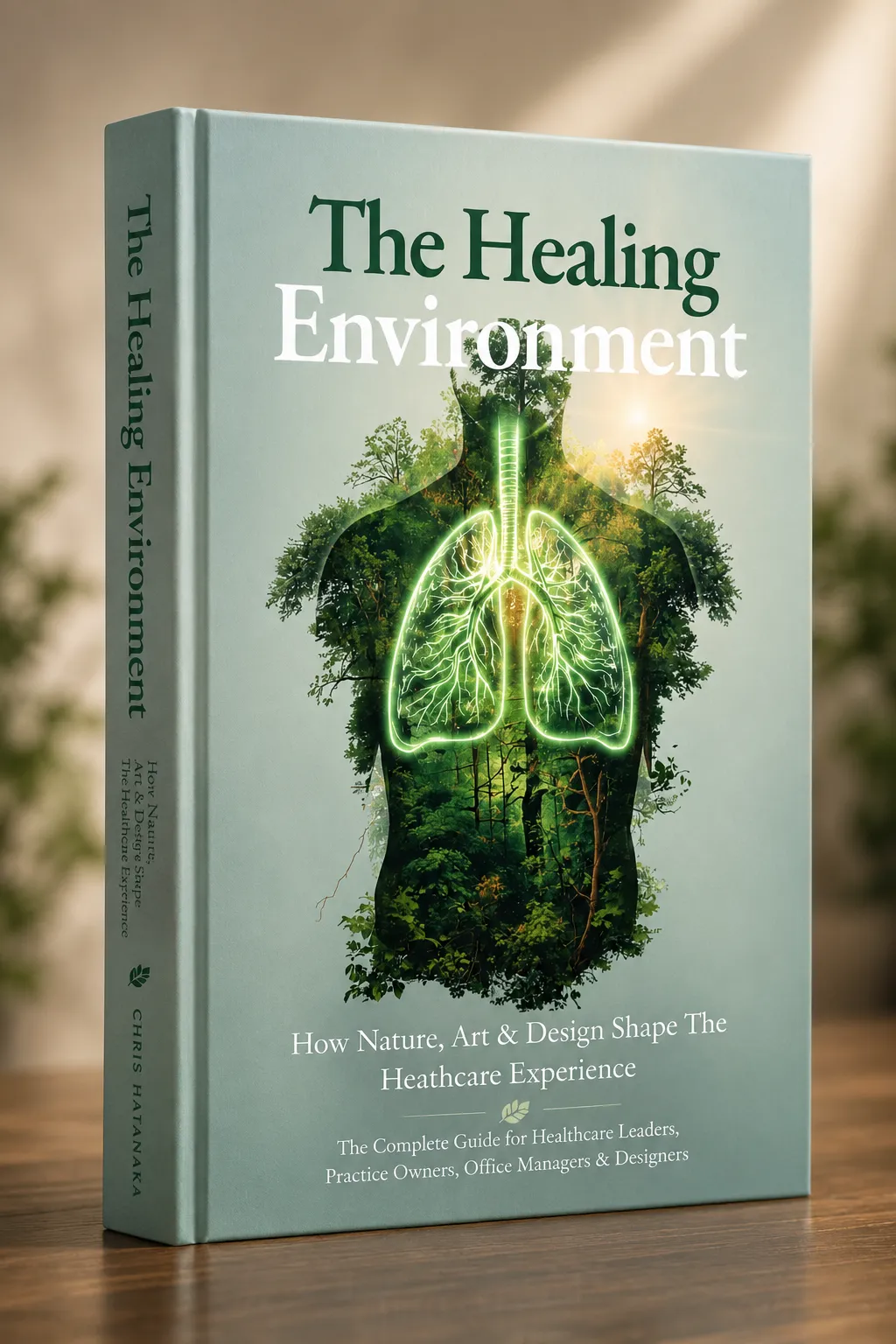
The Healing Environment | How Nature, Art & Design Shape the Healthcare Experience | The Complete Guide for Healthcare Leaders, Practice Owners, Office Managers & Designers
The Most Overlooked Part of Patient Care
Patients Begin Judging Your Practice Before Treatment Begins
Every healthcare leader shares the same mission.
Provide exceptional care.
It’s why practices invest in advanced technology, modern facilities, continuing education, and highly trained staff. Every decision is made with the patient in mind.
But here’s the question few healthcare professionals ever stop to ask:
When does the patient experience actually begin?
Is it when the physician walks into the exam room?
When treatment starts?
When a diagnosis is explained?
Or does it begin much earlier?
Imagine you’re visiting a healthcare facility for the very first time.
You haven’t met the receptionist.
You haven’t spoken to a nurse.
You haven’t shaken hands with your physician.
Yet your brain is already collecting information.
The cleanliness.
The lighting.
The sounds.
The layout.
The colors.
The atmosphere.
Within moments, you’ve already started forming an impression of the practice.
Whether you realize it or not, you’re asking yourself questions.
“Am I in the right place?”
“Can I trust these people?”
“Do they pay attention to details?”
“Will I receive exceptional care here?”
Most patients never consciously think through those questions.
But they begin answering them almost immediately.
And that’s where the patient experience truly begins.
The Hidden Cost of First Impressions
Healthcare professionals often think of patient care as something that begins with clinical interaction.
Patients don’t.
To them, every moment inside your practice is part of the experience.
The parking lot.
The front entrance.
The waiting room.
The hallway.
The treatment room.
Every detail quietly communicates something about your practice.
Some environments feel calm.
Others feel cold.
Some immediately inspire confidence.
Others unintentionally create anxiety.
The remarkable part is that most healthcare practices never intentionally design these experiences.
They simply happen.
Day after day.
Patient after patient.
Without anyone stopping to ask whether the environment itself is helping—or quietly working against everything the practice has worked so hard to build.
The Question Researchers Couldn’t Ignore
For decades, researchers focused almost exclusively on improving healthcare through better medicine, better technology, and better clinical outcomes.
But eventually, a different question began to emerge.
What if exceptional care wasn’t the only thing patients experienced?
What if the environment itself played a role in shaping how people felt from the moment they arrived?
It was a simple question.
Yet answering it would eventually reshape the way architects, psychologists, healthcare leaders, and researchers thought about hospitals, clinics, and medical practices around the world.
Because once they started looking…
They discovered something they hadn’t expected.
And it all started with something most people would never think twice about.
A hospital window.
It All Started With a Window
The Study That Changed Healthcare Design
For years, healthcare leaders focused on improving medicine.
Researchers focused on improving outcomes.
Architects focused on designing more efficient hospitals.
Very few people stopped to ask whether the building itself could influence the patient experience.
After all…
Hospitals existed to deliver healthcare.
The environment was simply where healthcare happened.
Or so everyone thought.
Then, in 1984, environmental psychologist Dr. Roger Ulrich asked a question that most people considered almost impossible to answer.
Could something as simple as the view from a hospital window influence a patient’s recovery?
It sounded almost absurd.
How could a tree compete with modern medicine?
How could a view outside a window possibly matter when patients were receiving the same physicians, the same nurses, and the same medical treatment?
To find out, Ulrich compared patients recovering from the same surgical procedure.
Everything about their care was remarkably similar.
The only meaningful difference was what they saw from their hospital bed.
Some patients looked out at a brick wall.
Others looked out at a small stand of trees.
What happened next surprised the medical community.
Patients with views of nature generally experienced shorter hospital stays, received fewer negative evaluative comments from nurses, and required fewer strong pain medications than patients whose windows overlooked a brick wall.
One study doesn’t change an industry.
But it can change the questions researchers begin asking.
And that’s exactly what happened.
One Study Became Four Decades of Research
Ulrich’s research didn’t end the conversation.
It started one.
Researchers around the world began asking similar questions.
What role does natural light play in healthcare environments?
Do healing gardens make a difference?
Can the design of a patient room influence the healthcare experience?
Does stress change when people are surrounded by nature?
Could thoughtfully designed environments improve the experience of patients, families, and even healthcare professionals?
Over the next four decades, researchers from medicine, psychology, architecture, neuroscience, and environmental design investigated these questions from every angle imaginable.
Different countries.
Different hospitals.
Different patient populations.
Different research methods.
No single study provided all the answers.
But together, they began painting a remarkably consistent picture.
The Pattern Researchers Couldn’t Ignore
As more evidence emerged, one theme kept appearing.
Not occasionally.
Consistently.
Researchers studying hospitals found it.
Researchers studying rehabilitation centers found it.
Researchers studying behavioral health facilities found it.
Healthcare architects found it.
Evidence-based designers found it.
Even when the studies explored different questions, they often pointed toward the same conclusion.
Nature mattered.
Not because researchers wanted it to.
Because the evidence kept leading them there.
The question was no longer whether nature belonged in the conversation.
The question became…
Why?
Why would trees…
Water…
Mountains…
Natural light…
And outdoor landscapes continue appearing throughout decades of healthcare research?
What was it about nature that made it so different?
The answer wasn’t simply beautiful scenery.
It was something far more deeply rooted in the way human beings experience the world around them.
And understanding that connection may be one of the most important discoveries in creating healthcare environments that truly support the people inside them.
Why Nature Keeps Appearing
Why Our Brains Respond to Natural Environments
By now, one question should be obvious.
If researchers continued finding evidence that nature influences the healthcare experience…
Why?
After all, a mountain can’t perform surgery.
A river can’t prescribe medication.
A forest can’t replace modern medicine.
So why have researchers spent more than four decades studying nature in healthcare environments?
The answer may have less to do with hospitals…
…and more to do with being human.
For nearly all of human history, people lived surrounded by forests, rivers, mountains, lakes, and open skies.
Long before hospitals existed…
Long before cities filled the landscape…
Nature wasn’t a destination.
It was home.
Our ancestors depended on natural environments for food, water, shelter, and survival. Over thousands of generations, our brains adapted to recognize the world around us in ways that helped us survive.
While researchers continue to study exactly how those adaptations influence us today, one idea continues to gain support:
The environments we occupy influence far more than where we stand.
They influence how we experience the world around us.
And that realization changed the direction of healthcare research forever.
The Science Behind Biophilic Design
As researchers continued exploring the relationship between people and their environments, a new idea began gaining attention.
What if humans possess an inherent connection to nature?
This concept eventually became known as Biophilia—a term describing humanity’s innate affinity for the natural world.
Whether through evolution, experience, or a combination of both, researchers have found that many people consistently respond positively to natural environments.
This doesn’t mean nature replaces medicine.
It doesn’t mean every patient will respond the same way.
But it does suggest something remarkably important.
The environment surrounding a patient isn’t neutral.
It can shape how a space feels.
How welcoming it appears.
How stressful—or calming—it seems.
How people remember the experience after they leave.
As these ideas evolved, architects and healthcare designers began asking a different question.
Instead of asking,
“How do we build better hospitals?”
They started asking,
“How do we build environments that better support the people inside them?”
That shift eventually became the foundation of what we now know as biophilic design—the intentional incorporation of natural elements into built environments to strengthen people’s connection with nature.
Today, those principles influence the design of hospitals, medical offices, behavioral health facilities, wellness centers, and healthcare practices around the world.
But biophilic design presented one obvious challenge.
Most healthcare practices aren’t built beside waterfalls.
Most patient rooms don’t overlook mountain ranges.
And very few waiting rooms sit in the middle of a forest.
So if patients can’t always experience nature directly…
How do you bring nature to them?
If Nature Matters… How Do We Bring It Indoors?
This became the next great question.
Healthcare designers couldn’t relocate every hospital into a national park.
But perhaps they didn’t have to.
Researchers began looking for practical ways to introduce the experience of nature into healthcare environments.
Natural light.
Healing gardens.
Indoor plants.
Natural materials.
Water features.
And eventually…
Artwork.
Not because artwork could replace a walk through the woods.
Not because a landscape photograph could heal a patient.
But because researchers wanted to understand whether thoughtfully selected imagery could help create environments that felt more connected to nature.
That question would lead to another fascinating discovery.
Researchers found that not all artwork creates the same experience.
Some images simply filled empty walls.
Others appeared to invite people somewhere else entirely.
And once researchers began comparing those differences…
The conversation around healthcare artwork changed forever.
The question was no longer:
“Should healthcare facilities display artwork?”
It became:
“What kind of artwork creates the experience we want our patients to have?”
And that’s where the research becomes especially interesting.
The Hidden Language of Healthcare Spaces
The Psychology of Color
Imagine walking into two different healthcare practices.
The first is filled with harsh fluorescent lighting.
Bright, highly saturated colors compete for your attention.
Large areas of intense reds and oranges dominate the walls.
The artwork feels visually busy.
Every surface seems to demand your attention.
Now imagine walking into another practice.
Natural light fills the room.
Soft blues.
Earth tones.
Greens.
Warm wood finishes.
A peaceful landscape stretches across one wall.
Without consciously thinking about it, most people immediately describe one space as feeling calmer than the other.
Why?
Because our brains don’t simply recognize color.
They respond to it.
Researchers have spent decades studying how hue, saturation, brightness, and contrast influence the way people perceive the environments around them. While no single color can guarantee a particular emotional response, studies suggest that color contributes to the overall atmosphere of a space and can influence how welcoming, stimulating, or restorative that environment feels.
Perhaps that’s why nature continues to appear throughout healthcare research.
Nature rarely overwhelms us with a single color.
Instead, it surrounds us with balanced palettes that have existed for thousands of years.
Soft greens.
Deep blues.
Warm earth tones.
Golden light.
Rather than competing for our attention, they work together to create visual harmony.
Healthcare environments can learn from that lesson.
Why Some Images Calm While Others Create Tension
Color is only one part of the story.
Imagine two photographs hanging side by side.
One shows a quiet mountain lake at sunrise.
Still water.
Soft light.
Gentle reflections.
The other captures a crowded city intersection.
Flashing lights.
Traffic.
Towering buildings.
Constant movement.
Neither photograph is inherently “better.”
But they communicate completely different experiences.
Researchers have found that people often respond differently to artwork depending on its subject matter, visual complexity, and composition. Images that are highly chaotic or visually demanding may create a different experience than artwork featuring recognizable natural scenes with visual depth and balance.
Think about the patients sitting in your waiting room.
Some are anxious.
Some are grieving.
Some have received life-changing news.
Others are simply waiting and wondering.
The artwork surrounding them becomes part of that moment.
It can compete for attention.
Or it can gently draw the mind somewhere else.
That’s one reason natural landscapes appear so frequently in healthcare environments.
They don’t ask the viewer to solve a puzzle.
They simply invite them to pause.
What Patients See When They Look Around the Room
One of the most overlooked truths about healthcare design is this:
Patients spend far more time looking at their surroundings than they do looking at their healthcare provider.
While they wait…
Their eyes wander.
Across the walls.
Toward the ceiling.
Down the hallway.
Through the windows.
They notice things your staff stopped seeing years ago.
The artwork.
The colors.
The lighting.
The cleanliness.
The details.
Every one of those elements contributes to a silent conversation.
Without speaking a single word, your environment tells patients what kind of practice you are.
Does it feel thoughtful?
Professional?
Warm?
Rushed?
Generic?
Intentional?
The remarkable thing is that this conversation begins long before treatment ever starts.
Which means every healthcare practice faces an important decision.
What story do you want your environment to tell?
Because once you begin viewing your practice through your patients’ eyes…
You realize the walls have been speaking all along.
The only question is whether they’re saying what you intended.
Not All Artwork Creates the Same Experience
Why Subject Matter Matters
Once healthcare leaders understand that the environment shapes the patient experience, another question naturally follows.
If artwork matters… what kind of artwork should we choose?
For many practices, the answer has traditionally been simple.
Find something that matches the paint color.
Fill the empty wall.
Move on.
But if the research throughout this guide tells us anything, it’s that artwork is more than decoration.
It’s part of the environment your patients experience.
That means the image itself deserves careful consideration.
Researchers studying patient preferences have consistently found that not all artwork is experienced the same way. While personal taste will always vary, patients often show a strong preference for recognizable natural scenes over abstract or visually complex imagery in healthcare settings.
Why?
Because natural landscapes ask very little of the viewer.
A quiet lake doesn’t need to be interpreted.
A mountain sunrise doesn’t require explanation.
A winding river doesn’t compete for attention.
Instead, these scenes allow the mind to wander.
For patients waiting for a diagnosis…
Recovering after surgery…
Receiving chemotherapy…
Or simply sitting alone with their thoughts…
That distinction matters.
Healthcare artwork shouldn’t become another source of mental stimulation.
It should become an opportunity to mentally step outside the clinical environment, if only for a moment.
When thoughtfully selected, artwork does more than decorate a room.
It changes how that room is experienced.
Why Size Changes Perception
Imagine standing in front of a breathtaking mountain landscape.
Now imagine looking at that same scene through a postcard.
It’s the same image.
But it’s not the same experience.
One of the most common mistakes healthcare practices make isn’t choosing poor artwork.
It’s choosing artwork that’s too small for the space.
Researchers have even explored whether the size of artwork changes how patients perceive healthcare environments.
Interestingly, the answer appears to be yes.
Studies have found that larger landscape images can create more positive perceptions of healthcare spaces than smaller versions of the exact same image.
Nothing else changed.
The subject remained identical.
Only the scale.
This makes intuitive sense.
Large artwork has the ability to become part of the room itself.
It creates depth.
Draws the eye.
Establishes a focal point.
Instead of asking patients to search for the artwork…
The artwork naturally becomes part of their experience.
When properly scaled, a landscape doesn’t simply hang on the wall.
It changes how the room feels.
Common Mistakes Healthcare Practices Make
By now, one thing has become clear.
Creating a healing environment isn’t about hanging artwork.
It’s about making intentional decisions.
Unfortunately, many healthcare practices unknowingly make the same mistakes.
Choosing artwork simply because it matches the décor.
Beautiful artwork should complement a space—but its purpose extends beyond matching paint colors.
Selecting images that create visual tension instead of visual relief.
Highly chaotic, overly abstract, or visually demanding artwork may not create the experience many healthcare environments are trying to achieve.
Using artwork that’s too small for the wall.
Tiny artwork on large walls rarely creates impact.
Instead, it often disappears into the room.
Treating every room the same.
A pediatric waiting room.
A behavioral health clinic.
A dental operatory.
A recovery suite.
Each serves a different purpose.
Each deserves artwork selected with that purpose in mind.
Thinking of artwork as decoration instead of part of the patient experience.
This may be the biggest mistake of all.
Because once you recognize that your environment is already communicating with every patient who walks through your doors…
The question is no longer whether artwork matters.
The question becomes…
What experience do you want your practice to create?
And answering that question begins with looking at your facility through a different set of eyes.
Not as the owner.
Not as the provider.
But as the patient.
Because that’s exactly where the next step begins.
Designing Spaces That Patients Remember
Research can tell us why healthcare environments matter.
But eventually, every practice must answer a much more practical question.
How do we apply it?
The goal isn’t simply to make your practice look more beautiful.
The goal is to create spaces that support the people who use them every day.
Patients.
Families.
Visitors.
Physicians.
Nurses.
Receptionists.
Every room tells a different story.
The artwork within those spaces should help tell the right one.
Waiting Rooms
Few places in healthcare carry more emotion than the waiting room.
For some, it’s simply a routine appointment.
For others, it’s where they wait for a diagnosis.
A loved one.
A life-changing conversation.
It’s where uncertainty lives.
Patients often spend far more time in the waiting room than they do with their healthcare provider. During that time, their attention naturally shifts to the environment around them.
Thoughtfully selected artwork can help transform that experience.
Large landscape photographs.
Expansive mountain vistas.
Quiet lakes.
Flowing rivers.
Images that create depth and invite the eye to wander naturally.
Rather than reminding patients they’re waiting…
They gently remind them there’s a world beyond the appointment they’re about to face.
Healthcare providers can’t eliminate every patient’s anxiety.
But they can create an environment that feels more welcoming, more intentional, and more human.
Sometimes that begins with something as simple as what hangs on the wall.
Treatment & Recovery Spaces
Treatment rooms serve a different purpose.
Patients often spend extended periods of time in these spaces.
Receiving infusions.
Recovering after procedures.
Waiting between appointments.
Sitting quietly with their thoughts.
During those moments, the room itself becomes part of the experience.
Artwork shouldn’t compete for attention.
It shouldn’t overwhelm the senses.
Instead, it should offer patients somewhere else to look.
Somewhere else to think.
Somewhere else to be.
A peaceful landscape can become a temporary escape.
A mountain sunrise can remind someone of a place they’ve visited.
A quiet forest trail can spark memories of time spent outdoors.
While no photograph replaces exceptional medical care, thoughtfully chosen artwork can help transform a clinical space into one that feels more welcoming and more personal.
That’s a meaningful difference for patients who may spend hours inside the same room.
Supporting Patients, Families & Staff
One of the most overlooked aspects of healthcare design is this:
Patients aren’t the only people experiencing your environment.
Families wait beside loved ones.
Children accompany parents.
Visitors walk your hallways.
And perhaps most importantly…
Your staff spends thousands of hours inside your facility every year.
The same hallways.
The same treatment rooms.
The same break rooms.
The same walls.
Healthcare professionals dedicate their lives to caring for others.
The environments they work in should care for them as well.
Thoughtfully designed spaces communicate something important to everyone who enters them.
They say…
“We care about the details.”
“We care about the experience.”
“We care about the people inside these walls.”
That’s the true purpose of a healing environment.
Not simply to decorate a building.
But to create a place where patients feel welcomed…
Families feel supported…
And healthcare professionals feel proud to work.
Because when every element of a practice is designed with intention…
People notice.
Even if they can’t explain exactly why.
Looking at Your Practice With Fresh Eyes
After reading this guide, I hope you’ll do one simple exercise.
Walk through your practice as if you’ve never been there before.
Sit in your waiting room.
Walk your hallways.
Stand in a treatment room.
Ask yourself:
What would my patients see?
What would they feel?
What story are these walls telling?
The answers may surprise you.
And they may reveal opportunities to create an even more welcoming, memorable, and intentional healthcare environment.
Because in the end, patients may not remember every word that was spoken during their visit.
But they will remember how your practice made them feel.
Now That You Understand What to Look For
By now, you’ve probably started looking at your own practice a little differently.
Maybe you’ve noticed a waiting room that feels cold.
A treatment room with blank walls.
Artwork that feels disconnected from the experience you’re trying to create.
Or perhaps you’ve realized that your environment has been communicating with patients long before anyone on your team says a single word.
That’s the power of intentional design.
Once you understand how the visual environment shapes the patient experience…
You can’t unsee it.
The good news is that creating a more thoughtful healthcare environment doesn’t require starting over.
It begins by selecting artwork with intention.
Not simply because it fills an empty wall.
But because it supports the experience you want patients, families, and staff to have every day.
Whether you’re designing a calming waiting room…
A restorative recovery space…
A welcoming reception area…
Or a peaceful treatment room…
The right image can help transform how that space is experienced.
To make that process easier, I’ve organized my photography into collections designed for specific healthcare environments.
Rather than wondering which image belongs where, you can browse curated galleries created with each type of space in mind.
Explore Curated Collections
Waiting Rooms
Large, welcoming landscapes that create a memorable first impression and help establish a calm, inviting atmosphere.
Treatment & Exam Rooms
Quiet scenes that encourage reflection and provide patients with a peaceful focal point during appointments or procedures.
Recovery & Infusion Spaces
Images chosen to create a sense of openness, hope, and connection to the natural world during longer visits.
Hallways & Common Areas
Cohesive collections that transform transitional spaces into memorable visual journeys.
Staff Lounges & Break Rooms
Nature photography selected to create restorative environments for the people who spend the most time caring for others.
Every photograph has been captured in some of North America’s most extraordinary landscapes—from the sandstone cliffs of Zion National Park to the remote wilderness of Alaska—and is available in a variety of sizes and finishes to complement your space.
Continue Exploring
Choose the space you’re designing below to view a collection of images selected specifically for that environment.
Browse Waiting Room Artwork
Browse Treatment Room Artwork
Browse Recovery Room Artwork
Browse Hallway Collections
Browse Staff Space Artwork


